

A Factory Manager’s Checklist Before Buying an Industrial Lift
Most industrial lift failures trace back to procurement, when a question gets skipped during the buying process and nobody notices until the lift is already installed.Before signing a purchase order for an industrial lift, goods lift, or vertical reciprocating conveyor (VRC),
You Should Verify These Things First:
– Confirm actual load and duty.
– Verify safety standards and certifications.
– Check manufacturer’s installation history
– Review lifetime cost beyond invoice.
– Match site readiness with engineering drawings.
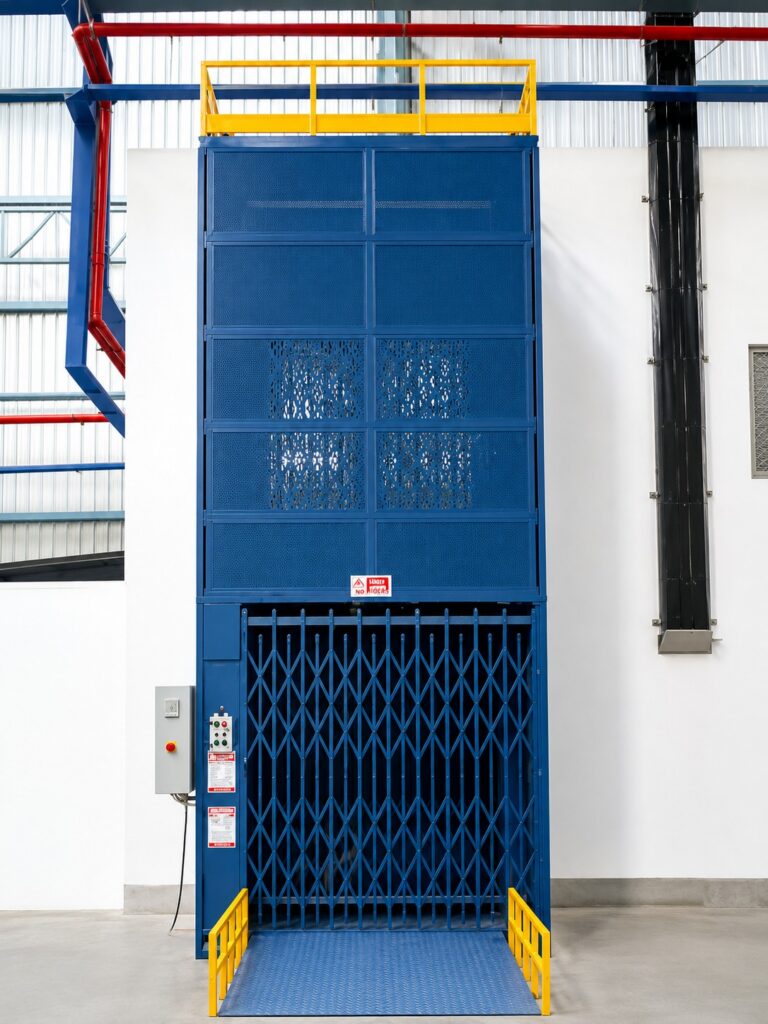
Confirm The Actual Load And Duty Cycle, Not the Estimated One
Every industrial lift carries a rated maximum load, but the figure that determines how it holds up over years of use is duty cycle: how many times a day the lift runs, how long each cycle takes, and whether the load stays consistent or varies.
A lift specified for occasional heavy loads is engineered differently from one built for constant cycling at moderate load: different hydraulics, different structural fatigue tolerances, and different motor duty ratings. Specifying the wrong one rarely causes immediate failure; instead, it shows up later as accelerated wear and a service life shorter than the invoice implied.
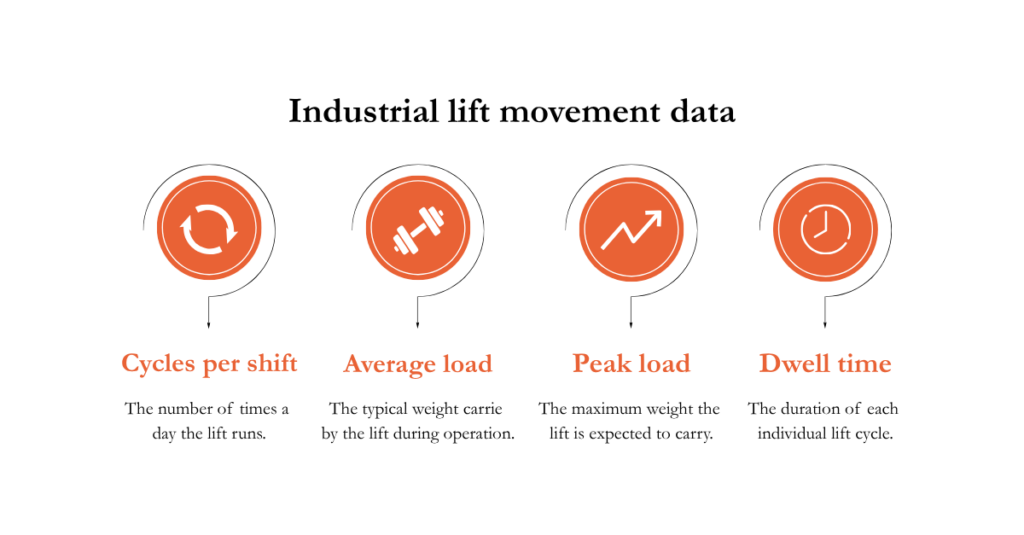
Before quoting, pull real movement data from the floor: cycles per shift, average load, peak load, and dwell time, rather than working from a rounded estimate. Share those figures with the supplier and let the engineering follow your actual usage pattern.
Verify Which Safety Standard the Lift Is Certified Against
This is where buyers are most often misled, usually without anyone intending it, because industrial lifts in India sit under more than one regulatory layer at once. The Factories Act sets baseline safety obligations for equipment used in a factory setting. Individual state Lift Acts and Lift Rules govern installation and periodic inspection and vary by state. IS 17900 is the current Indian Standard covering lifts built to transport persons and goods.
Vertical reciprocating conveyors sit in a separate category, since by design they aren’t built to carry people. Manufacturers building VRCs typically reference ASME B20.1, the American standard for conveyors and material handling equipment, as the relevant design benchmark. It doesn’t substitute for Indian regulatory compliance, but it is the standard most directly applicable to a VRC’s engineering, alongside whatever state-level rules apply to your installation.
Ask which of these apply to your state and your specific lift type, and ask to see the certificate itself, not a general assurance that it’s certified.
Verify The Manufacturer’s Track Record and Who Built the Lift
A product can be assembled quickly, but a verifiable history of installations is harder to fabricate. Ask how long the manufacturer has been building industrial lifts specifically, not industrial equipment in general, and request reference sites in an industry comparable to yours, then follow up on them directly rather than taking the list at face value. This matters more for lifts than for most industrial equipment, since a failure here is a safety incident, not just a cost problem.
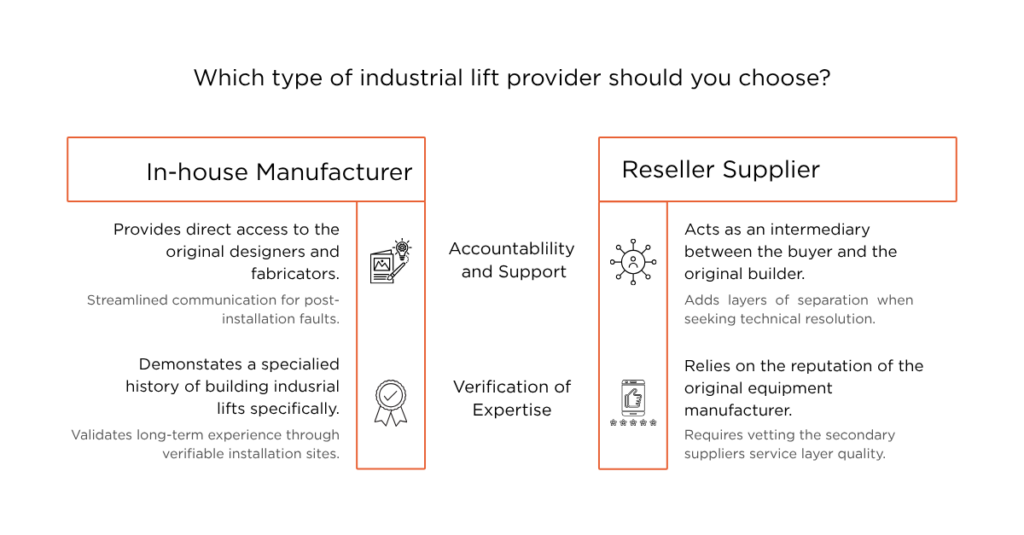
Not every company quoting an industrial lift built it: some are manufacturers with their own engineering and fabrication in-house, while others are suppliers or dealers reselling another company’s product, sometimes with a service layer added on top. Neither structure is wrong on its own, but it changes who is accountable when something needs attention after installation and how many steps stand between you and the people who actually built the machine. Before purchase, ask plainly who designed and fabricated the lift, and who you will be contacting directly if a fault appears after installation.
Price The Lifetime Cost, Not Just The Invoice
The purchase price is the smallest figure in an industrial lift’s lifetime cost. Maintenance terms, spare part availability, and expected service life carry more weight over the years the lift stays in operation.
Before signing, ask three things directly:
- AMC coverage → What exactly is included?
- Spare parts → How are they sourced and how fast do they reach your site?
- Service history → What’s the track record on lifts of similar age?
Confirm Site Readiness Against Actual Engineering Drawings
Pit depth, headroom, power supply specification, and structural load-bearing at the installation point all need to be checked against the lift’s engineering drawings, not assumed from a general site layout. This step gets skipped more often than it should, usually because civil work and lift supply are handled by separate contractors who never cross-check their requirements against each other.
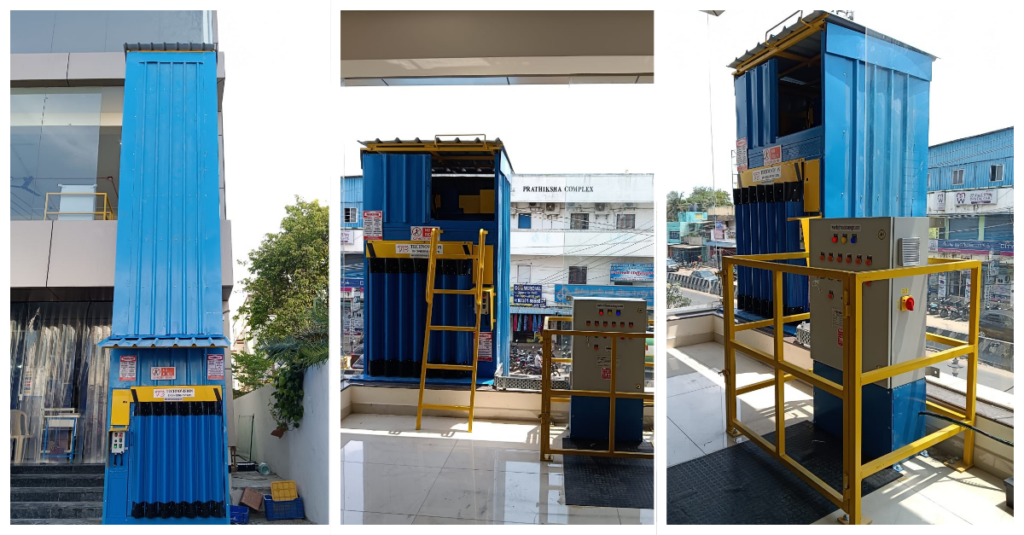
Here’s a glimpse of our Outdoor lift installation
A manufacturer who insists on reviewing your site conditions before finalising a design is doing the part of the job that protects you during installation. A supplier willing to quote a fixed price without asking for site dimensions is skipping a step you’ll likely pay for later, in change orders or a lift that doesn’t fit the pit it was meant for.
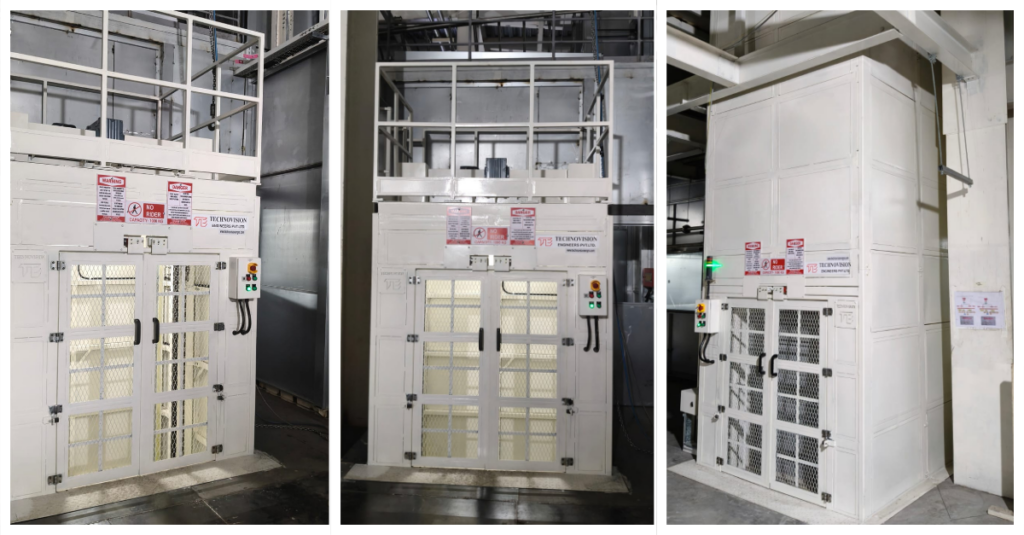
Here’s a glimpse of our indoor lift installation
An industrial lift becomes part of your production line for years once it’s installed, so what’s really at stake in this decision is your project timeline, your budget, and the safety of everyone working near it. Getting the procurement decision right the first time costs considerably less than correcting it later. If you’re working through this list for an active project, Technovision Engineers Private Limited’s engineering team can walk your load and duty cycle before you finalise a supplier.
Contact us to know more: Phone: +91 7774020056
Email: sales@technovisionengrs.com Website: www.technovisionengrs.com
Tags: Industrial Lift, Industrial Goods Lift, Goods Lift, Industrial Elevator, Goods Elevator, Mezzanine Lift, Mezzanine Goods Lift, VRC, VRC Lift, Vertical Reciprocating Conveyor, Electric Goods Lift, Electro Mechanical Goods Lift, Chain Drive Factory Lift, Warehouse Lift, Heavy Duty Industrial Lift, Customized Industrial Lift, Industrial Material Lift, Vertical Lift, Warehouse Material Handling, Industrial Material Handling, Goods Hoist, Factory Goods Elevator