

Can You Install an Industrial Lift Outdoors? Here’s What Actually Changes in the Design.
If you’re setting up a new warehouse or dark store and you don’t have the floor space to wall off a lift room, this question comes up almost every time: can we put the industrial lift outside, right in the open, exposed to sun and monsoon? We hear it from warehouse managers trying to get a site live before a deadline and from plant heads who don’t want a service call three months in because someone misjudged the weather.
Can You Install an Industrial Lift Outdoors?
Yes, you can. But an outdoor industrial lift isn’t just an indoor unit placed under the sky. We design it for that exposure from the first drawing, which means the coating, the structure covering, and sometimes even the foundation get planned around the site conditions before fabrication starts. Rather than patched in once the build is already underway.
How much does Indian weather actually affect an outdoor industrial lift?
Less than most people expect. When clients ask about weatherproofing, they’re usually picturing freezing, ice, or snow load, but that’s not really what an industrial lift (VRC) installed in most parts of India has to deal with. What it does deal with is sun exposure that fades and weakens ordinary paint over time, monsoon rain that finds its way into every seam it can, and humidity that sits in the air for months. It slowly works on any untreated metal. We handle all three with epoxy paint combined with a precoated structure sheet, and that combination is what carries an outdoor unit through an Indian summer and monsoon without needing anything more elaborate.
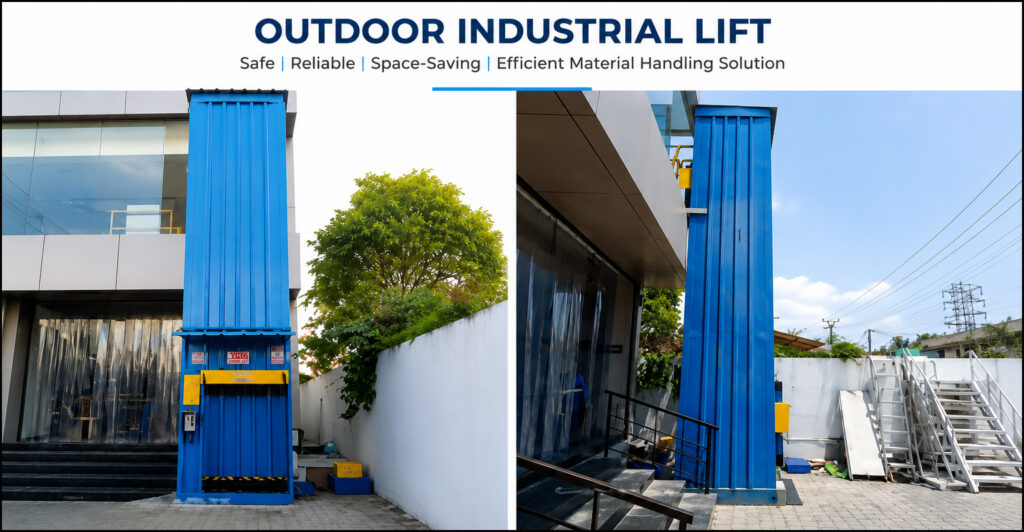
What actually keeps an outdoor industrial lift from rusting?
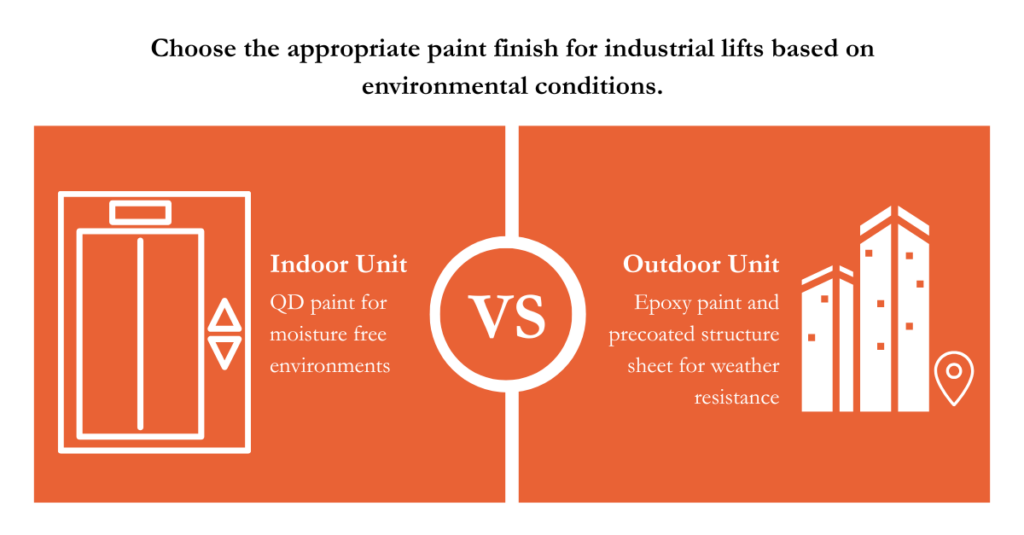
It comes down to two different approaches because an indoor unit and an outdoor unit are dealing with entirely different conditions.
- An indoor Industrial lift (VRC) gets a QD, or quick-dry, paint finish, and that’s genuinely sufficient since there’s no real moisture exposure happening inside four walls.
- An outdoor Industrial lift (VRC) gets epoxy paint along with a separately precoated structure sheet, which is a distinct specification from the paint itself, and the two work together as a layered defense against everything the outdoors throws at it.
If a vendor ever quotes you the same finish for both your indoor and outdoor units, that’s worth a direct question, because in our experience it’s rare to see identical treatment applied across two environments with such different demands
Does an outdoor installation need a different foundation?
No. Pit-style and ramp-style foundations both work perfectly well in the open air. What actually decides which one you require is the layout of your building and how your floors and access points are arranged, and that’s true whether the lift ends up indoors or outdoors.
Does the inspection schedule change for an outdoor unit?
No, an outdoor industrial lift follows the same inspection cycle as an indoor one. There’s no separate maintenance calendar just because it happens to be installed in the open.
The detail warehouse teams almost always miss: ceiling height
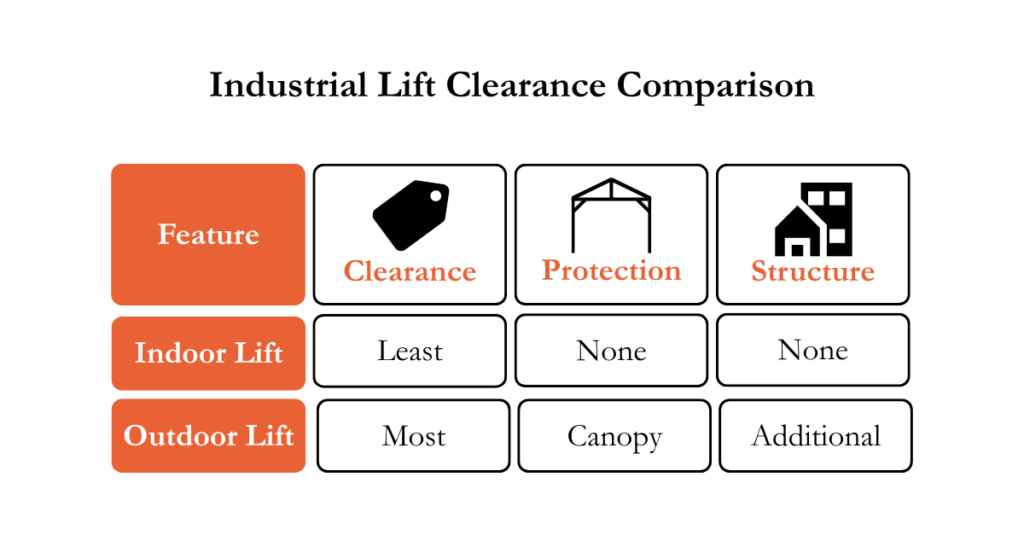
This is the one that catches people out, so check it early if you’re comparing indoor and outdoor layouts for a new site.
- Indoor industrial lift: needs the least clearance compared to an outdoor unit.
- Outdoor industrial lift: requires the most because of the additional structure and canopy required to protect it.
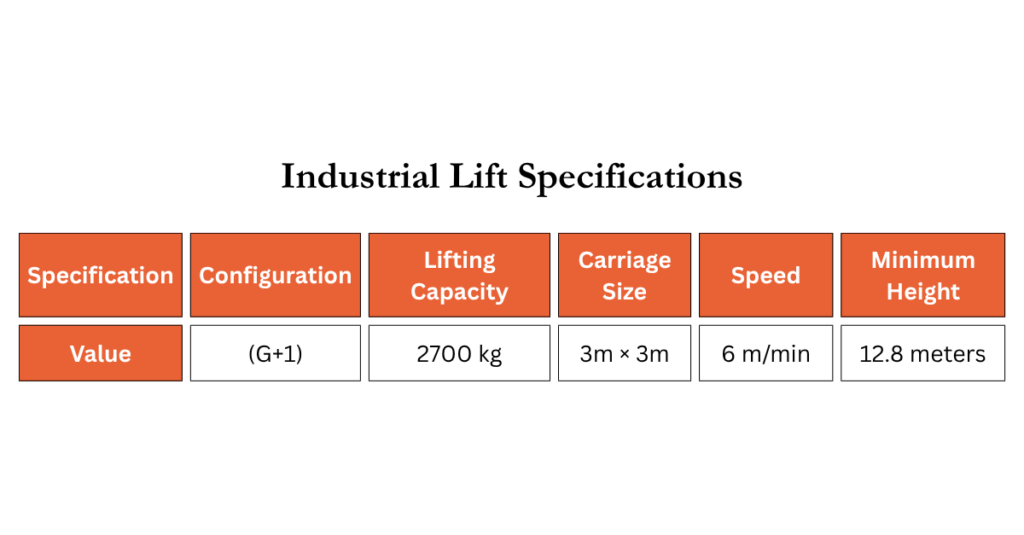
- For example, we installed a four-post industrial lift (VRC) like this for a sheet metal components client, G plus one configuration, 2700-kilogram lifting capacity, 3m × 3m carriage, running at 6 meters a minute. The GA drawing called for a minimum height of 12.8 meters to clear the outer structure and canopy, and we confirmed that number with the client before finalizing the design.
If you spot this too late on your site, you’ll end up redesigning the whole layout right before launch, with no extra time or budget to deal with it.
Why this matters before you finalize a layout
For a warehouse manager trying to hit throughput targets or a plant head approving on capital expenditure, the real risk isn’t whether an industrial lift can survive outside. It can, when it’s engineered for it. The risk is treating outdoor placement as a minor site detail instead of a design decision that needs to be settled before drawings are finalized. Because that’s precisely where floor bottlenecks, delayed go-live dates, and unplanned civil work tend to come from.
If you’re working through a site layout and need to confirm what an outdoor installation would need on your floor, get in touch with us directly.
For more Details Contact Us
- Phone: +91 7774020056
- Email: sales@technovisionengrs.com
- Website: www.technovisionengrs.com
Tags: Industrial Lift, Industrial Lift Manufacturers, Industrial Lift Supplier, Industrial Goods Lift, Industrial Goods Lift Manufacturer, Industrial Goods Lift Supplier, Industrial Goods Lift Manufacturer in Pune, Industrial Goods Lift Manufacturer in Maharashtra, Industrial Goods Lift Manufacturer in India, Vertical Industrial Lift, Heavy Duty Industrial Lift, Warehouse Lift, Factory Goods Lift, Heavy Duty Industrial Goods Lift, Industrial Freight Lift, Industrial Lift Solutions, Industrial Lift Installation, Outdoor Industrial Lift