

C-flow Vs Z-flow: Which Continuous Vertical Conveyor (CVC) Fits Your Warehouse
Most warehouse managers research vertical material movement on land on two very different technologies without realizing it: reciprocating lifts that stop, load, and move, and continuous vertical conveyors that keep running without pausing for each load. If your operation moves a steady stream of cartons, totes, or crates between floors and stopping the line for each cycle is costing you throughput, a Continuous Vertical Conveyor, or CVC, is worth understanding properly before you spec one.
What A Continuous Vertical Conveyor Does
A continuous vertical conveyor is an automated system that moves materials up or down between floor levels without interrupting the flow the way a reciprocating lift does. Instead of a single carrier stopping at each level to load and unload, a CVC keeps a continuous cycle of carriers moving, which means loading and unloading can happen without waiting for the previous cycle to finish. For operations with steady, repetitive vertical movement, that difference in flow directly affects throughput.
This is not the right equipment for every application. A CVC is built for lightweight, continuous flow, cartons, plastic crates, gunny bags, and similar loads. If your material stream is pallet loaded, you are looking at a different category of equipment entirely, a vertical reciprocating conveyor (VRC) or a goods lift suited to that weight range.
C-flow And Z-flow: The Difference That Matters
CVCs come in two basic configurations, and the difference between them comes down to where material enters and exits relative to where it started.
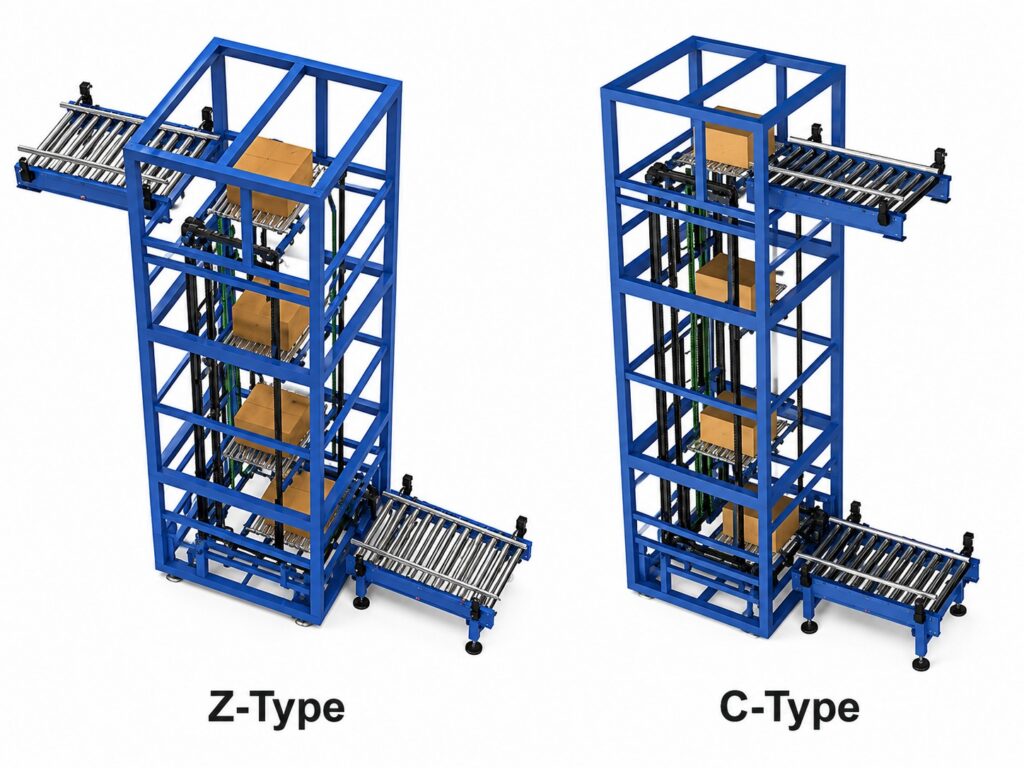
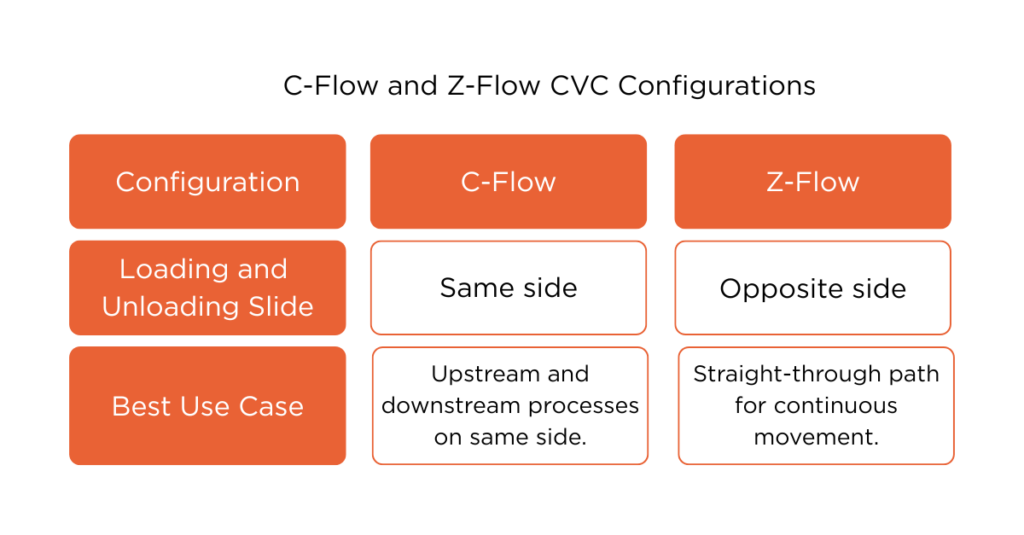
- A C-Flow configuration loads and unloads material on the same side. Material goes in and comes back out on the same face of the machine, which suits layouts where the upstream and downstream processes is on the same side of the facility, or where floor space on the opposite side isn’t available for infeed and outfeed lines.
- A Z-Flow configuration loads on one side and unloads on the opposite side, giving the layout a straight through path rather than a return to the same point. This suits facilities where material needs to keep moving in one direction through the building, rather than looping back toward where it started.
Neither configuration is better in the abstract. The right one depends entirely on how your floor is laid out and which direction your material actually needs to travel once it reaches the next level.
What The Specifications Tell You Before You Buy
A CVC’s usable range is defined by simple limits, not marketing fluff. It’s built for small, repetitive loads, making it a flow tool rather than a bulk mover.
- Carriage size: Up to 800 × 800 mm, fits cartons, crates, gunny bags.
- Weight range: 5-40 kg per load, lightweight handling.
- Application: High‑frequency movement of small to medium loads, not oversized or palletized.
Height matters too, and it’s worth checking early: a CVC is designed for continuous flow between levels, and its practical operating range narrows as height increases, so confirming the vertical distance you actually need against a supplier’s stated maximum before committing to a layout will save a redesign later.
Where Continuous Vertical Conveyors Fit
The applications that suit a CVC share one trait with a steady, repetitive stream of lightweight material moving between levels rather than occasional heavy lifts.
- Warehouses and distribution centers use them to move cartons and dispatch materials between storage and picking floors.
- FMCG and packaging operations use them to keep packaged goods flowing between production and packaging levels without interrupting the line.
- Automotive and general manufacturing plants use them for components and sub-assemblies moving between process floors.
- E-commerce and logistics facilities use them for order flow between receiving, sorting, and dispatch levels.
If your facility is a multi-level operation with a genuinely continuous flow of light material, rather than periodic heavy loads, this category of equipment is built for exactly that problem.
Getting The Spec Right Before You Commit
The mistake worth avoiding is treating a CVC as a general-purpose vertical lift and specifying it after the fact. The load range, carriage size, and flow direction all need to match your actual material stream and floor layout from the start, not be adjusted around a machine that was chosen first. Confirm your typical load weight and size, decide whether your layout calls for same side or opposite side flow, and check the throughput your upstream and downstream processes can sustain before finalizing a configuration.
Get those and a Continuous Vertical Conveyor solves a real problem.
Contact us to know more: Phone: +91 7774020056
Email: sales@technovisionengrs.com Website: www.technovisionengrs.com
Tags: Continuous Vertical Conveyor, CVC Conveyor, C-Flow Conveyor, Z-Flow Conveyor, Vertical Conveyor System, Vertical Material Conveyor, Vertical Goods Conveyor, Industrial Conveyor, Conveyor System, Material Handling Equipment, Material Handling Solutions, Warehouse Automation, Automated Material Handling, Vertical Material Handling, Warehouse Conveyor, Industrial Automation, Warehouse Solutions, Vertical Reciprocating Conveyor, VRC, Technovision Engineers, Vertical Material Handling, Vertical Conveyor,Vertical Material Lifting, Vertical Goods Lifting, Industrial Vertical Lift, Material Lifting Equipment